
Saying Yes to Shenzhen

“Should I apply? Do I even qualify for this program?”
Coming from a non-business background, a startup program initially felt distant and unfamiliar. Yet the next thing I knew, I was on a midnight flight with other UQ students to Shenzhen, China. 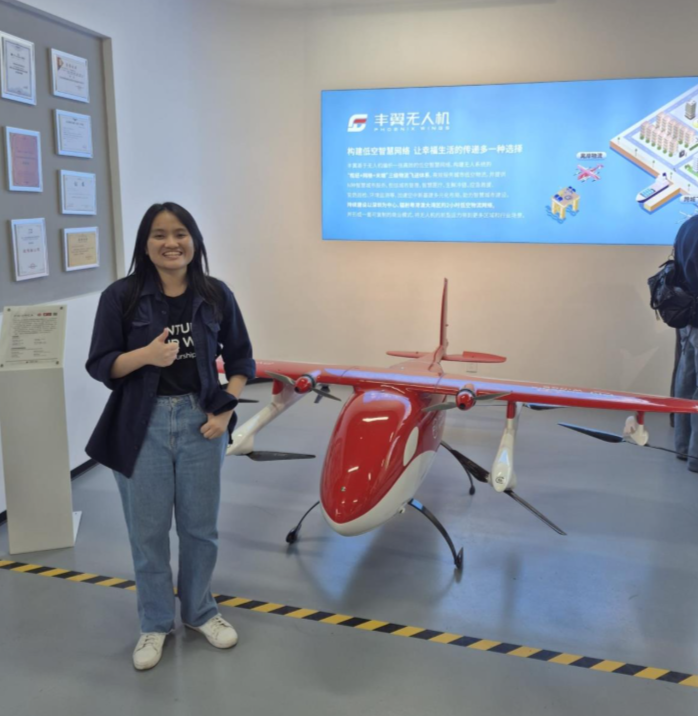
I’m Juventia Soewardi, a Master of Sustainable Energy (Management) student at The University of Queensland. Most of my work revolves around energy systems, climate, and data analytics — not pitch decks or business strategy.
But I soon realised something important: sustainable solutions do not rely solely on technology. They require viable business models, effective execution, and supportive ecosystems to scale impact.
 Soon after, I found myself placed with Shenzhen Bixuange Technology, a company specialising in IoT (Internet of Things) monitoring equipment, environmental data visualisation, and advanced weather simulation systems. What unfolded over the next 4 weeks refined how I view innovation. Not as disruption, but as coordination between systems, people, and opportunities.
Chapter One: AI Exploration and Prototyping
From the first week, we were immersed directly in Bixuange’s past projects. After learning about my energy background, the team shared how weather intelligence data integrates into renewable energy and infrastructure applications.
I experimented with Chinese AI tools like Doubao and Yuanbao to visualise environmental datasets, then compared the outputs with ChatGPT. The differences in response style and application focus were revealing. It was not simply about which tool performed better, but about understanding how technology evolves within different ecosystems. Each platform reflected the priorities of the market it serves.
Beyond office discussions, we joined a prototyping workshop in Huaqiangbei, the world’s largest electronics market. Within 2 hours, our team ideated and built a portable motion sensor using Arduino components. Inspired by how silent electric bikes move swiftly across Shenzhen streets, we wanted to create a low-cost alert system for pedestrians, especially people with disabilities, to enhance reaction time and safety.
What stood out was not just the speed, but the accessibility. When infrastructure, supply chains, and technical expertise align, ideas move rapidly from concept to reality. Innovation felt less like dramatic disruption and more like deliberate coordination.

Chapter 2: Founders, International Exhibition, and Ecosystems
Meeting business founders, professionals, and UQ alumni was another defining experience. Each followed a different pathway into entrepreneurship. Some pivoted industries entirely. Others built partnerships at the right moment. What became clear was that entrepreneurship is not only about ideas — it is about relationships, timing, and adaptability.
I also visited an International Electronics Circuit Exhibition in Shenzhen. Walking through halls filled with robotics, laser hardware systems, AI platforms, and industrial automation technologies, I observed how companies strategically position their products for both domestic and global markets. It was not just about having advanced technology; it was about storytelling, positioning, and scalability. Innovation, I realised, is also about communication.
Chapter 3: Market Research and Company Visit
After understanding Bixuange’s business model, we conducted a market research study exploring expansion opportunities. We analysed potential industries, regulatory considerations, competitive landscapes, and preliminary financial estimations.
For me, this was where my analytical background met entrepreneurial thinking.
It was no longer just about “Is this technology impressive?” but rather “Is this commercially viable? Where does it create the most value?”
We also visited a drone technology company in Shenzhen, witnessing live monitoring systems and aerial delivery solutions — from hospital logistics to everyday food delivery integrations. Technology here is not futuristic; it is seamlessly embedded into daily life. Practical, efficient, and quietly transformative. 
Chapter 4: Sunday Reflection at Lianhuashan Park
Sunday visits to the park became moments of quiet reflection. Families of all ages gathered, food deliveries arrived by drone, children played Go with robots, and locals sang karaoke beneath the skyline. At the top of Lianhuashan Park, the city stretched endlessly — a reminder of how seamlessly technology and everyday life coexist in Shenzhen.
I reflected on the question I once asked myself in the beginning - do I even qualify for this program?
The answer was not about being fully prepared. It was about being willing to grow.
Saying yes to Shenzhen did not transform me into a startup founder overnight. Instead, it gave me clarity that bridging technology, business, and ecosystems is where meaningful impact happens.
If you are a student who is hesitating to apply for this experience because you do not come from a business background, I once felt the same. Sometimes growth begins not with certainty, but with curiosity and the willingness to to step forward.